
Make Every Bite Count
U N S H A K E A B L E
PEPTALK · PEPTIDES UNPACKED
Built for the ones who don't slow down. Who expect a lot from their body.
Who are here to live better, longer.
Make Every Bite Count: The Nutrition Mindset That Works on GLP-1 Therapy
One of the most common mistakes people make when starting GLP-1 therapy is treating it like a passive process. The appetite suppression kicks in, they eat less, they lose weight — and they assume the rest will take care of itself.
It doesn't.
What GLP-1 therapy actually does is create a window — a period where your stomach empties more slowly, fullness signals arrive earlier, and the constant background noise of food cravings quiets down. What you put inside that window is entirely up to you. And it matters more than most people realize.
Karli Sine, who lost 55 pounds on semaglutide and has maintained for over two and a half years, learned this the hard way. So did Jessica Briecke, who watched clients lose muscle mass while eating donuts for breakfast because no one had told them that the tool only works when you work with it. Here's what they've learned.
Protein First. Every Time.
This is the single most important nutritional principle for anyone on GLP-1 therapy, and it's non-negotiable: eat your protein first.
Here's why. GLP-1 peptides slow stomach emptying, which means food sits in your stomach longer and fullness arrives faster. If you sit down to a meal and reach for the bread, the pasta, or the salad first, you may be full before you've eaten a gram of meaningful protein. That's a problem — because without adequate protein, your body will draw on muscle tissue to meet its needs during weight loss.
Muscle loss during GLP-1 therapy is real. Jessica Briecke experienced it firsthand with clients — she could literally feel the difference in their tissue during massage sessions. Clients who were doing CrossFit and Pilates multiple times a week were losing muscle because their diets weren't supporting what the peptide was doing to their body composition.
The fix is simple but requires a genuine mindset shift: every meal starts with protein. Chicken, beef, fish, eggs, Greek yogurt — whatever form works for you. Get that protein in first, then fill in with vegetables, fats, and complex carbohydrates if there's room.
The Salad Myth
Here's something that might be uncomfortable to hear: most salads are not good meals for people on GLP-1 therapy. Or really for anyone trying to build a genuinely nourishing diet.
The salad as a health food is a cultural artifact — a legacy of the calorie-restriction era when "eating light" meant eating leaves. But a typical salad is mostly water and fiber-light vegetables, with a small amount of protein scattered on top and often a dressing that adds more calories than nutrition.
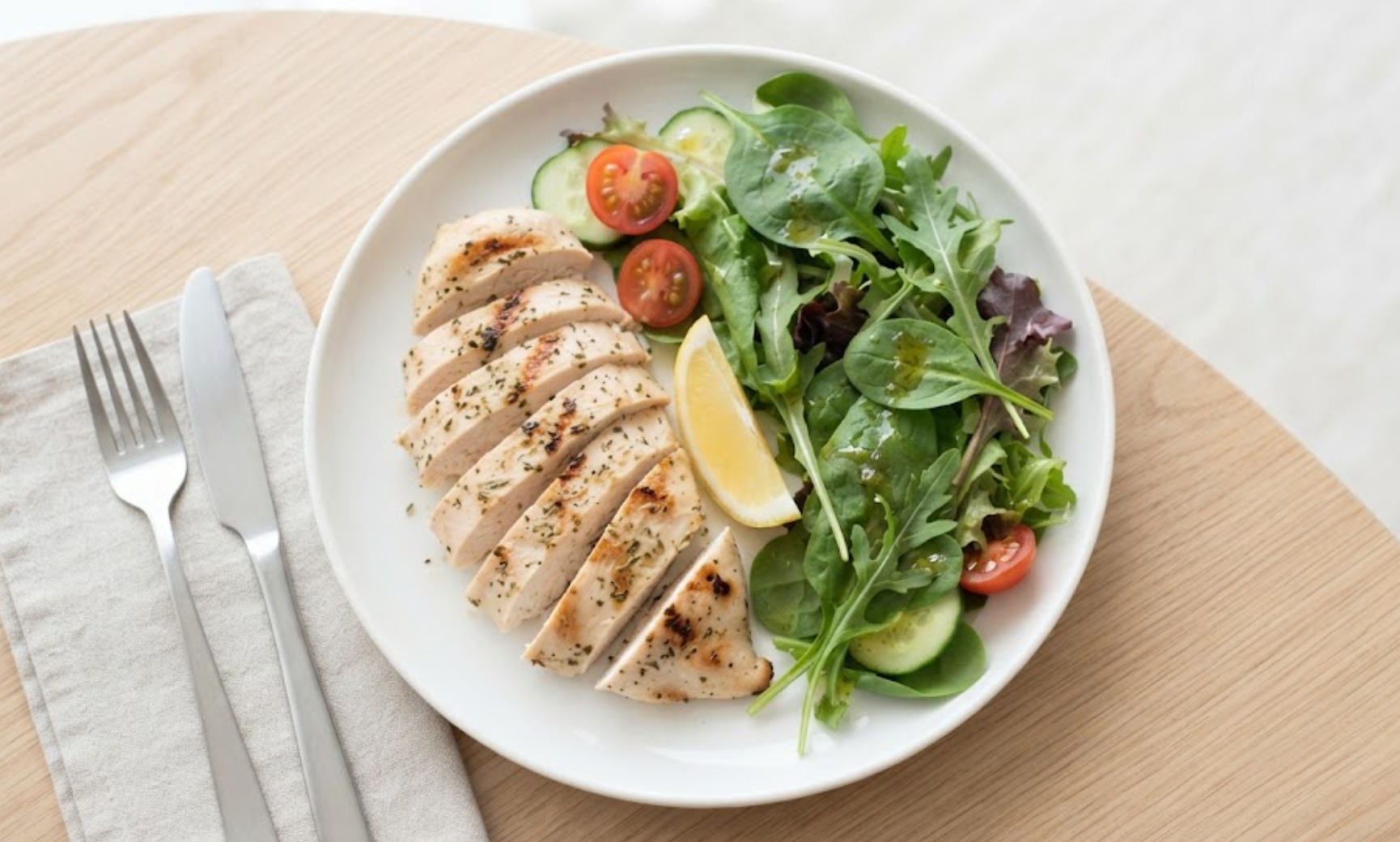
That doesn't mean never eat a salad. It means build it differently. A genuinely nourishing salad starts with a meaningful protein — not a garnish of it — uses a small bed of greens rather than a massive volume of low-nutrient leaves, includes healthy fats from avocado or olive oil, and uses a dressing made from real ingredients rather than seed oil and sugar.
If you finish a salad and you're hungry again within an hour, the salad didn't serve you. Reach for something that will.
The Generational Food Script Problem
One of the underappreciated barriers to success on GLP-1 therapy is the programming most of us received around food in childhood. Clean your plate. Don't waste food. Eat everything that's in front of you.
These messages weren't wrong in context — they came from generations that had genuine scarcity concerns. But they created adults who override fullness signals, eat past satiety out of obligation, and feel guilty when they leave food on a plate.
GLP-1 therapy directly confronts this programming. The medication restores the fullness signals that many people with insulin resistance and metabolic dysfunction have never properly felt. And when those signals arrive, the old scripts kick in and fight back.
The reframe that Dr. Kylie Burton uses with her own children is worth borrowing: instead of "did you finish your plate?" ask "is your tummy happy?" It's a small shift, but it teaches the skill of listening to the body's actual signals — which is exactly what GLP-1 therapy is trying to restore.
Hydration: The Factor That Determines Whether the Tool Works
If there is a single foundational requirement for GLP-1 therapy to work effectively, it's water. Karli traces many of her early side effects not to the medication but to being significantly underhydrated while her body was adjusting to major metabolic changes.
The minimum recommendation from the obesity specialist Karli worked with: 60 ounces per day while on these peptides. More is better — she worked her way up to 80+ ounces daily. That's not a casual suggestion. It's a functional requirement.
Why does it matter so much? GLP-1 therapy changes how the gut processes food and fluids. Without adequate water, constipation and nausea become more likely, nutrient absorption is impaired, and the metabolic shifts the peptide is trying to facilitate are working against a dehydrated system.
The Metabolic Snapshot Test
Dr. Kylie Burton offers a simple, practical way to assess where your metabolic health currently sits: the one-bite test.
Can you take a single bite of a Hershey's bar and put it down? One bite of a donut and walk away? If yes, your insulin signaling is likely working reasonably well. If the answer is no — if one bite triggers a compulsion to finish the whole thing — that's not a willpower failure. That's a metabolic signal that the system needs support.
GLP-1 therapy, paired with the right nutritional foundations, helps restore that signaling. And when it's restored, the relationship with food changes in ways that feel almost unbelievable to people who've struggled with cravings and overconsumption their whole lives.
The bottom line
GLP-1 therapy is a tool. Like any tool, its effectiveness depends on how it's used. Pair it with protein-first eating, adequate hydration, and a willingness to unlearn the food scripts that have been running on autopilot since childhood — and the results can be genuinely transformative. Expect the peptide to do all the work without changing the foundations, and the results will be modest at best.
Here to help you become Unshakeable,

Dr. Kylie
This blog is based on Episode 6 of PepTalk: Peptides Unpacked, hosted by Dr. Kylie Burton and Jessica Briecke.
Learn more at drkylieburton.com
Legal Disclaimer: Every person's health journey is unique. The experiences shared here are real stories from real people working with medical professionals. Your results may differ. Peptide therapy is a prescription treatment that requires doctor supervision. We partner with a telemedicine company that provides access to licensed physicians to assist you in your peptide therapy journey.